The best .177 pellets for pigeons offer air rifle shooters a practical combination of accuracy, consistent performance, and value for money.
With options featuring different pellet weights, hollowpoint designs, and aerodynamic shapes, you can find ammunition suited to your rifle and shooting requirements.
In this guide, we review top pellet choices, highlights their key features, and compares their advantages and limitations. You’ll also discover the essential factors to consider when buying .177 pellets, along with answers to frequently asked questions to help you make an informed decision for lawful pest control and target practice.
About Pigeons
Pigeons are medium sized birds commonly found in cities, farms, gardens, and rural areas. They feed on seeds, grains, and other food sources, and often gather around buildings, livestock feeding areas, and grain storage facilities.
Although they play a role in the ecosystem by dispersing seeds and providing food for predators, large pigeon populations can create problems through droppings, property damage, and contamination of stored feed.
Managing pigeon populations starts with prevention, including removing accessible food sources, securing grain storage, and blocking nesting or roosting sites where appropriate. Where pigeon control is necessary, use humane, lawful methods and check local wildlife regulations before taking action.
Any pest management approach should also consider public health, animal welfare, and the safety of people and other wildlife.
Below is a Summary of our Top Picls .177 Pellets for Pigeons
- JSB Predator Polymag .177, 8.0 Grains — Best Overall
- H&N Baracuda Hunter Extreme .177, 9.57 Grains — Best Heavyweight Option
- H&N Terminator Hollowpoint .177, 7.25 Grains — Best Lightweight Option
- Benjamin Hollow Point .177, 7.9 Grains — Best Budget Hunting Pellet
- Crosman Premier Hollow Point .177, 7.9 Grains — Best Affordable All Rounder
Best .177 Pellets for Pigeons
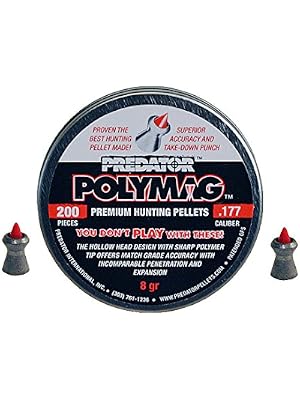
1) JSB Predator Polymag .177, 8.0 Grains
The JSB Predator Polymag .177, 8.0 Grains is a premium hunting pellet designed for air rifle shooters who want precise shot placement and effective terminal performance. Its pointed polymer tip and hollow head combine penetration with an expanding design, making it an option for pest control and lawful pigeon hunting where permitted.
With its aerodynamic profile and 8.0 grain weight, this pellet is worth considering for shooters who prioritize accuracy at typical air rifle hunting distances. It is particularly suited to single shot rifles and compatible PCP platforms.
The polymer tipped design distinguishes the Polymag from conventional lead pellets. Its pointed nose is designed to aid penetration, while the hollow cavity behind the tip supports expansion on impact. Actual results depend on the rifle’s power, pellet fit, impact velocity and shot placement, so testing accuracy with your own air rifle is essential.
Priced above many standard .177 pellets, the JSB Predator Polymag is best suited to shooters who value precision over low cost per shot. A tin contains 200 pellets, making it a practical option for focused hunting sessions rather than extensive target practice.
Specifications
- Caliber: .177 (4.5mm)
- Pellet Weight: 8.0 grains
- Design: Polymer tipped hollow head
- Material: Lead core with polymer tip
- Pellet Style: Pointed polymer tip with hollow cavity
- Quantity: 200 pellets per tin
- Intended Use: Hunting and pest control
- Flight Profile: Aerodynamic design
- Accuracy: Rifle dependent; test for consistent grouping
- Effective Range: Approximately 25 to 50 yards, depending on rifle power and conditions
- Compatibility: Compatible single shot and selected PCP or spring piston rifles
- Price Range: Approximately $24 to $28 per tin
Pros
- Polymer tipped design combines a pointed nose with a hollow cavity.
- Can deliver excellent accuracy in air rifles that suit its pellet design.
- Suitable for hunting applications where lawful and appropriate.
- 8.0 grain weight offers a useful option for .177 air rifles.
- Aerodynamic profile supports stable flight when matched to the rifle.
- Great accuracy and terminal performance.
Cons
- Premium pricing makes it more expensive than many conventional pellets.
2) H&N Baracuda Hunter Extreme .177, 9.57 Grains
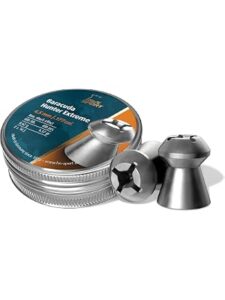
The H&N Baracuda Hunter Extreme .177, 9.57 Grains is a premium hunting pellet designed for air rifle shooters who want consistent accuracy and strong impact performance. Its heavier 9.57 grain weight makes it worth considering for pigeon hunting with a suitably powered air rifle, particularly for shooters who prioritize precision over the lowest cost per pellet.
Its four notch hollowpoint design is intended to promote expansion on impact, while the lead alloy construction provides a conventional hunting pellet profile. H&N specifically lists pigeons among its intended hunting targets, making this pellet relevant for lawful pigeon control when used with an appropriate air rifle and in accordance with local regulations.
Accuracy is an important consideration, with tight groups and consistent performance with rifles that suit this pellet. Results depend on barrel compatibility, rifle power, shooting conditions and distance. Testing groups at a measured range is the best way to establish whether the Baracuda Hunter Extreme performs reliably in your particular air rifle.
Each tin contains 400 pellets, offering a reasonable supply for occasional hunting and accuracy testing. The premium price is worthwhile for shooters seeking a dedicated hunting pellet.
Specifications
- Caliber: .177 (4.5mm)
- Pellet Weight: 9.57 grains
- Head Design: Four notch hollowpoint
- Material: Lead alloy
- Expansion Design: Hollowpoint intended to promote mushrooming on impact
- Quantity: 400 pellets per tin
- Intended Use: Hunting and pest control, including pigeons
- Minimum Muzzle Energy: Approximately 12 ft lbs,
- Muzzle Velocity: Approximately 745 FPS
- Velocity at 25 Yards: Approximately 607 FPS
- Energy at 25 Yards: Approximately 8 ft lbs
- Effective Range: Around 25 to 55 yards
- Recommended Platforms: Suitable high power PCP and compatible magnum air rifles
- Price Range: Approximately $24 to $30 per tin
Pros
- Specifically ideal for pigeon hunting and other pest control applications.
- Hollowpoint design intended to promote expansion on impact.
- Heavier 9.57 grain weight may suit appropriately powered hunting rifles.
- Can deliver tight groups in air rifles that perform well with this pellet.
- 400 pellets per tin provide a useful supply for hunting and testing.
- Strong impact performance and consistent accuracy.
Cons
- The heavier weight may not perform well in lower powered air rifles.
- Premium pricing makes it more expensive than many standard .177 pellets.
3) H&N Terminator Hollowpoint .177, 7.25 Grains
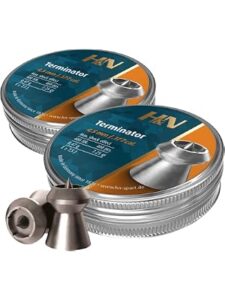
The H&N Terminator Hollowpoint .177, 7.25 Grains is a hunting pellet designed for air rifle shooters who want a balance of accuracy, speed, and impact performance. Its lightweight construction makes it an option for pigeon control at moderate distances, while its specialized head design distinguishes it from conventional round nose pellets.
The Terminator features a notched hollowpoint with a raised center point. This design combines a pointed central section with a hollow cavity intended to encourage expansion on impact. For shooters who need a dedicated hunting pellet, this configuration offers an alternative to standard lead pellets, although actual performance depends on the rifle and impact conditions.
Accuracy is another reason to consider this pellet. Its 7.25 grain weight may work well in suitable break barrel, spring piston, and PCP rifles, but it is important to test grouping and trajectory with your own setup before relying on it in the field.
Each package contains 800 pellets across two 400 count tins, giving you a generous supply for practice and occasional hunting. Its relatively affordable cost per pellet makes it appealing to budget conscious shooters.
Specifications
- Caliber: .177 (4.5mm)
- Pellet Weight: 7.25 grains
- Head Design: Notched hollowpoint with raised center point
- Material: Lead alloy
- Expansion Design: Hollowpoint with notched edges
- Quantity: 800 pellets in two 400 count tins
- Intended Use: Hunting and pest control
- Hunting Range: Approximately 20 to 40 yards
- Accuracy: Rifle dependent
- Compatibility: Suitable break barrel, spring piston, and PCP rifles, subject to testing
- Price Range: Approximately $20 to $28 per 800 pellet package
Pros
- Specialized hollowpoint design intended to promote expansion on impact.
- Lightweight 7.25 grain construction may suit moderate distance hunting.
- Can produce tight groups in compatible air rifles.
- Compatible with a range of air rifle platforms.
- 800 pellets per package offer good quantity for practice and hunting.
- Relatively affordable cost per pellet compared with many premium hunting options.
Cons
- Lightweight design may lose energy more quickly at longer distances than heavier alternatives.
4) Benjamin Hollow Point .177, 7.9 Grains
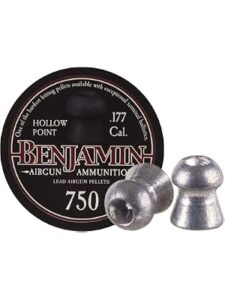
The Benjamin Hollow Point .177, 7.9 Grains is a budget friendly hunting pellet designed for air rifle shooters who want reliable accuracy and useful impact performance without spending heavily on ammunition. Its 7.9 grain weight makes it an option for small game hunting, while the expanding hollowpoint design is intended to increase deformation on impact.
For pigeon control, this pellet offers a practical combination of a conventional lead construction and a hollowpoint head. It is designed for small game hunting and may suit compatible break barrel, spring piston, and PCP rifles. Actual results depend on your rifle’s power, barrel compatibility, shot placement, and shooting conditions.
Accuracy is another reason to consider the Benjamin Hollow Point, with tight groups at shorter distances, including quarter sized groupings at 75 feet with compatible rifles. Since pellet performance varies between air guns, testing several groups on paper before field use helps establish whether this ammunition delivers consistent results in your setup.
Value is a major advantage, with approximately 750 pellets per container at a comparatively affordable price. This generous quantity makes it suitable for shooters who want ammunition for both practice and occasional hunting.
Specifications
- Caliber: .177 (4.5mm)
- Pellet Weight: 7.9 grains
- Head Design: Expanding hollowpoint
- Material: Lead
- Pellet Shape: Hollowpoint
- Quantity: 750 pellets per container
- Country of Origin: United States
- Intended Use: Small game hunting and pest control
- Accuracy: Rifle dependent
- Impact Performance: Hollowpoint design intended to promote expansion on impact
- Hunting Range: Approximately 30 to 50 yards, depending on rifle performance and conditions
- Compatibility: Suitable break barrel, spring piston, and PCP rifles, subject to testing
- Price Range: Approximately $10 to $14 per container
Pros
- Designed for small game hunting and pest control.
- Expanding hollowpoint head is intended to promote deformation on impact.
- 7.9 grain weight offers a versatile option for compatible .177 air rifles.
- Can produce tight groups in rifles that perform well with this pellet.
- Large 750 pellet container provides plenty of ammunition for practice and hunting.
- Affordable price makes it appealing to budget conscious shooters.
Cons
- Some pellets may have inconsistent sizing or fit in certain rifles.
5) Crosman Premier Hollow Point .177, 7.9 Grains
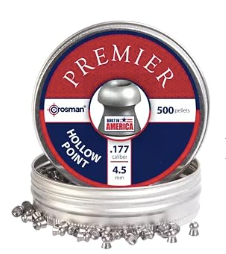
The Crosman Premier Hollow Point .177, 7.9 Grains is a budget friendly hunting pellet designed for shooters who want a practical balance of accuracy, impact performance, and affordability. Its 7.9 grain weight makes it a versatile option for compatible .177 air rifles, while its hollowpoint design is intended to promote expansion on impact.
For pigeon hunting, this pellet offers a conventional lead construction and an expanding hollowpoint head suited to small game applications. It is designed for small game hunting and pest control, making it worth considering for lawful pigeon control when used with an appropriate air rifle and in accordance with local regulations. Actual effectiveness depends on the rifle’s power, shot placement, and shooting conditions.
Accuracy is another appealing quality. Some shooters report tight groups at 30 yards and consistent results across different air rifle platforms.
The 500 count tin offers a useful supply for hunting and target practice without a high initial cost. Its competitive price makes it attractive to shooters who want to keep ammunition expenses manageable. The Crosman Premier Hollow Point remains a practical option for budget conscious air rifle owners.
Specifications
- Caliber: .177 (4.5mm)
- Pellet Weight: 7.9 grains
- Head Design: Expanding hollowpoint
- Material: Lead
- Pellet Shape: Hollowpoint
- Quantity: 500 pellets per tin
- Intended Use: Small game hunting and pest control
- Expansion: Designed to deform on impact
- Accuracy: Rifle dependent; tight groups at 30 yards
- Hunting Range: Approximately 20 to 45 yards, depending on rifle performance and conditions
- Compatibility: Suitable break barrel, spring piston, PCP, and compatible CO2 air rifles
- Price Range: Approximately $8 to $12 per tin, subject to retailer pricing
Pros
- Designed for small game hunting and pest control.
- Hollowpoint construction is intended to promote expansion on impact.
- 7.9 grain weight offers a versatile option for compatible .177 air rifles.
- Can deliver tight groups when matched to the rifle.
- Compatible with a variety of air rifle platforms.
- Affordable pricing makes it suitable for budget conscious shooters.
- A 500 pellet tin provides a useful supply for practice and hunting.
Cons
- Pellet fit may vary between rifle models, affecting loading and accuracy.
Read Also: 7 Best 177 Pellets for Squirrels
Advantages of Using the Best .177 Pellets for Pigeons
Improved Accuracy
Quality .177 pellets can deliver consistent accuracy when matched to a compatible air rifle. Their weight, shape, and manufacturing consistency influence how they travel toward the target. Choosing pellets that group well in your rifle helps improve shot placement and makes target practice more productive.
Effective Hollowpoint Designs
Hollowpoint pellets are designed to deform on impact, potentially increasing their effectiveness for small game applications. Their performance depends on pellet construction, impact velocity, and the air rifle being used. Selecting a suitable design helps match the ammunition to the intended purpose.
Wide Selection of Pellet Weights
.177 pellets are available in different weights, allowing shooters to find an option suited to their air rifle’s power and intended use. Lighter pellets may travel faster in some rifles, while heavier pellets can behave differently in flight. Testing several suitable weights helps identify the best balance of accuracy and consistency.
Affordable Shooting Practice
Many .177 hunting pellets come in tins containing hundreds of pellets, making them practical for regular target practice and rifle testing. Budget friendly options allow shooters to compare accuracy and performance without spending heavily on ammunition. Larger tins can also reduce the frequency of replacement purchases.
Compatibility With Different Air Rifles
The .177 caliber is widely used in break barrel, spring piston, and pre charged pneumatic air rifles, as well as some compatible CO2 models. This gives shooters a broad selection of pellet designs and weights to test. Checking the rifle manufacturer’s recommendations and confirming which pellets group best helps ensure reliable performance.
Better Consistency Through Pellet Testing
Testing different pellet types at known distances helps reveal which option performs most consistently in a particular air rifle. Shooters can compare group sizes, loading fit, and point of impact on paper targets before settling on a pellet. Consistent accuracy is especially important for humane pest control, which should only be undertaken where lawful and with a suitable air rifle, a safe backstop, and a clear target identification.
Factors to Consider When Choosing the Best .177 Pellets for Pigeons
Pellet Weight
Pellet weight affects velocity, trajectory, and how consistently a pellet performs in your air rifle. Common .177 hunting pellets range from lightweight designs to heavier options intended for more powerful rifles. Choose a weight suited to your rifle’s power and test its accuracy at the distances you intend to shoot.
Pellet Design
Pellets come in several shapes, including hollowpoint, domed, pointed, and wadcutter designs. Hollowpoint pellets are designed to expand on impact, while domed pellets are often favored for consistent accuracy across different distances. Consider the intended use and prioritize dependable accuracy over appearance or shape alone.
Accuracy and Consistency
Accuracy is essential when selecting pellets for any shooting application. A pellet that produces tight, repeatable groups on paper is generally a better choice than one that performs inconsistently. Test different pellet types from a stable position and compare group sizes at realistic distances before settling on one.
Air Rifle Compatibility
Not every pellet performs equally well in every air rifle, even when the caliber matches. Differences in barrel design, power, and pellet fit can affect accuracy and consistency. Check the manufacturer’s recommendations and test a few suitable options to determine which pellets work best with your specific rifle.
Shooting Distance
The distance between the shooter and the target affects pellet trajectory and accuracy. Lightweight pellets may lose velocity more quickly in some conditions, while heavier pellets may produce a different trajectory depending on muzzle energy. Test at the distances you expect to shoot, and avoid taking shots beyond the range at which you can maintain reliable accuracy.
Pellet Quality and Manufacturing Consistency
Uniform pellet shape, weight, and dimensions can help produce more predictable results. Poorly formed pellets may fit inconsistently or cause larger groups. Inspect pellets for obvious damage, deformed skirts, or irregular shapes, and store them in a dry place to help prevent damage before use.
Price and Quantity
Pellet prices vary according to brand, design, weight, and tin size. Larger tins can offer better value for regular practice, while smaller tins let you test different pellet types before buying in bulk. Compare the cost per pellet, but make accuracy and compatibility the priority rather than choosing solely on the lowest price.
Frequently Asked Questions
What grain .177 pellet is best for pigeons?
The best pellet weight depends on your air rifle’s power, barrel compatibility, and accuracy. Common .177 hunting pellets weigh around 7 to 10 grains, but no single weight works best in every rifle. Test different suitable weights on paper targets to identify which produces the most consistent groups.
Are hollowpoint pellets good for pigeon hunting?
Hollowpoint pellets are designed to deform on impact and are commonly marketed for small game hunting. However, their performance depends on pellet design, impact velocity, and air rifle power. Choose ammunition that performs consistently in your rifle, and follow local regulations when managing pest birds.
How far can you shoot pigeons with a .177 air rifle?
The effective range varies with the rifle’s power, pellet choice, wind conditions, and the shooter’s accuracy. Some setups can produce consistent groups at 20 to 30 yards, while others perform differently. Test your rifle at measured distances and avoid shots unless you can ensure a humane outcome and a safe backstop.
Conclusion
The best .177 pellets for pigeons comes down to finding the right balance of accuracy, pellet weight, design, and compatibility with your air rifle.
Hollowpoint pellets may suit certain small game applications, while other designs can offer consistent accuracy depending on the rifle. Before buying in bulk, test different pellet types at your intended shooting distances and compare their grouping performance.
Consider pellet quality and overall value, and always follow local regulations for pigeon control, prioritize humane outcomes, and use your air rifle only where it is lawful and safe.